Jiayun Zou, Technical University of Munich, discusses his article: Biodiversity associations between aboveground and belowground communities in mountain forests across different climatic regions
How tightly are the biological communities above and below the forest floor connected? In mountain forests, those associations remain poorly understood. While plants and soil microbes interact intimately, such as through symbioses or nutrient exchange, most evidence for these associations comes from grasslands or a few experiments within single forest sites. It remains unclear whether such associations in natural forests are consistent across broader climatic and environmental gradients.
A large-scale survey across climate zones
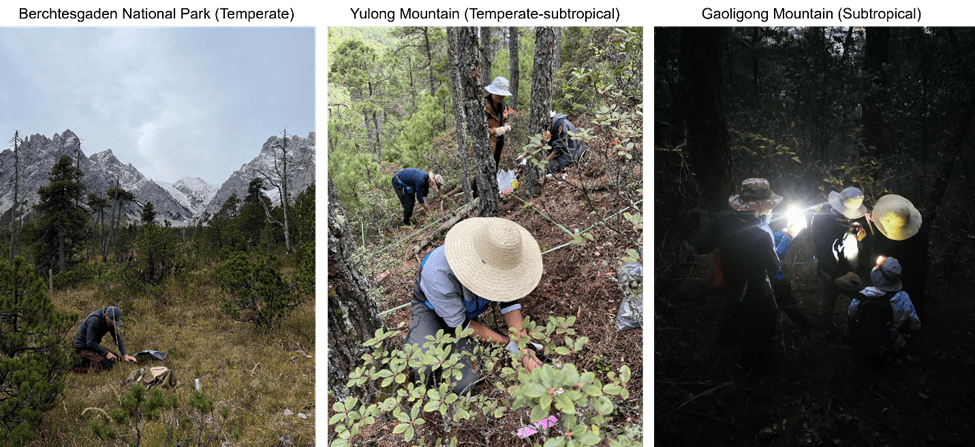
To explore this, we analyzed comprehensive inventory data from 186 permanent forest plots distributed along elevation gradients across three mountain landscapes, spanning subtropical, temperate-subtropical, and temperate climate zones. At each plot, we recorded woody and herbaceous plant communities, and characterized soil fungal and bacterial communities using metabarcoding. By combining these data with measurements of key soil properties and microclimate variables, we quantified how plant and microbial diversity were associated at both alpha and beta (species compositional difference) diversity levels, using Hill numbers with sample coverage standardization.
Patterns of plant-soil microbe diversity associations
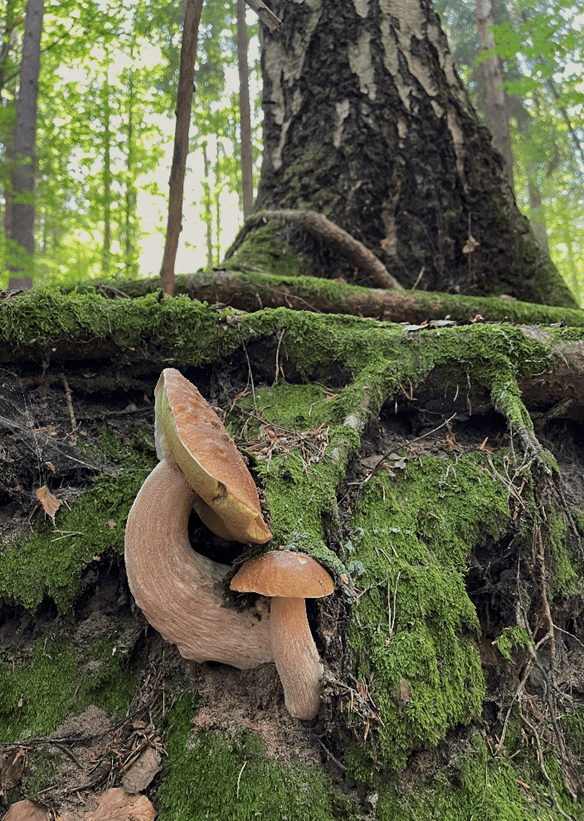
We found that soil fungi and plants had stronger diversity associations than soil bacteria and plants. This was especially pronounced at the beta diversity level, where differences in plant community composition were echoed by differences in fungal community composition. This pattern was consistent across all three landscapes, even after accounting for shared environmental influences such as soil conditions and temperature. In contrast, plant-bacterial diversity associations were weaker and more variable. This difference likely reflects the deeper evolutionary relationships between plants and fungi, such as direct symbiotic associations that extend beyond simply responding to the shared environment. Alpha diversity associations were more context-dependent, with fungal diversity more closely associated with herbaceous than woody plant diversity, highlighting the distinct roles that different plant life forms play in shaping belowground communities.
Varying associations along climatic and elevational gradients
The strength of these aboveground-belowground diversity associations changed with climate and elevation. Overall, associations tended to be stronger in lower-latitude forests and at intermediate elevations. When local abiotic conditions were accounted for, some associations weakened, but several plant-fungal associations remained strong, suggesting that biotic interactions complement abiotic environmental effects. These results showed a nuanced picture of the association between plants and soil microbes in mountain forests, and how it is shaped by both the type of organism and the local environment.
Why this matters
Understanding how aboveground and belowground communities are associated is essential for predicting how forests will respond to ongoing global change. Because plant and soil microbial communities are linked to one another, environmental changes affecting one part of the system may also influence the other, either directly through altered abiotic conditions or indirectly through changed biotic interactions. Our work also suggests that areas where these associations are particularly pronounced, like low-latitude and mid-elevation forests, could be crucial for maintaining ecosystem stability. Considering both aboveground and belowground biodiversity together may ultimately help guide more effective conservation under a changing climate.


