Robert Dunn and Steve Pennings, University of Houston, discuss their article: Variable trait responses to rapid sea level rise in a foundational grass across a coastal marsh landscape
One strategy that plants utilize to survive across a range of environmental conditions is to alter the expression of their traits. Functional traits are the characteristics of an individual plant that determine its growth, survival, and reproduction (for example: taller stems may give an advantage in competition for light and larger flower size may attract more pollinators). Describing how these traits change across environmental gradients within a single species has been a goal of trait-based ecology for decades, but this area of research is particularly important now as global change and other anthropogenic stressors modify the environmental conditions plants are experiencing.
Coastal marshes are experiencing rising water levels
Many coastal wetlands are currently threatened by rapid sea level rise (SLR). This increase in water levels along coastlines can lead to marshes being converted to open water or mud flats – a process called marsh drowning. One way to understand if wetlands are vulnerable to, or currently experiencing, drowning is to investigate plant traits that can vary through time in response to changing environmental conditions. We used data collected over 25 years from the Georgia Coastal Ecosystems Long-Term Ecological Research (GCE-LTER) site, along the Atlantic coast in the southeast United States. This is an area that has experienced substantial SLR over the past century, with even more rapid increases in water levels over the past 25 years. Each fall, we count and measure every stem within permanent plots at eight marshes dominated by the salt marsh grass Spartina alterniflora (subsequently referred to as Spartina).
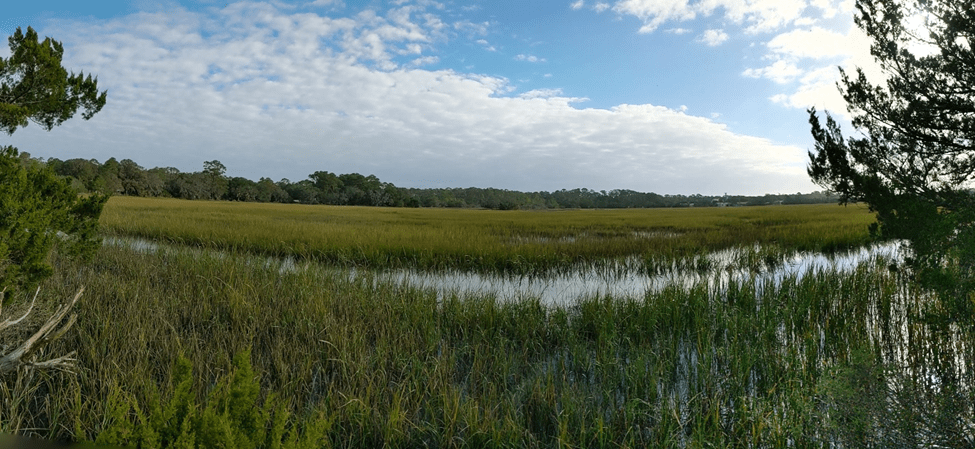
We tested for temporal trends in six traits across the eight GCE marsh sites dominated by Spartina. This species exhibits a clear relationship between inundation time and growth, with plants growing along creekbanks being taller and with more biomass, but in lower densities (‘tall form’ Spartina). Plants growing at higher elevation (thus spending less time inundated by the tide) are shorter and grow at higher densities (‘short-form’ Spartina). We expected increases in some traits (mean and maximum shoot height, biomass, size at flowering, and proportion of plants flowering) and decreases in other traits (stem density – defined as the number of stems in a specific area) at mid-marsh locations that are experiencing more inundation over time due to SLR. Likewise, we did not expect strong changes in plant traits along creekbanks because these plants are already located near their maximum level of inundation. Put another way, our research question was: are plants growing in the mid-marsh beginning to look like creekbank plants because they are experiencing more time underwater?
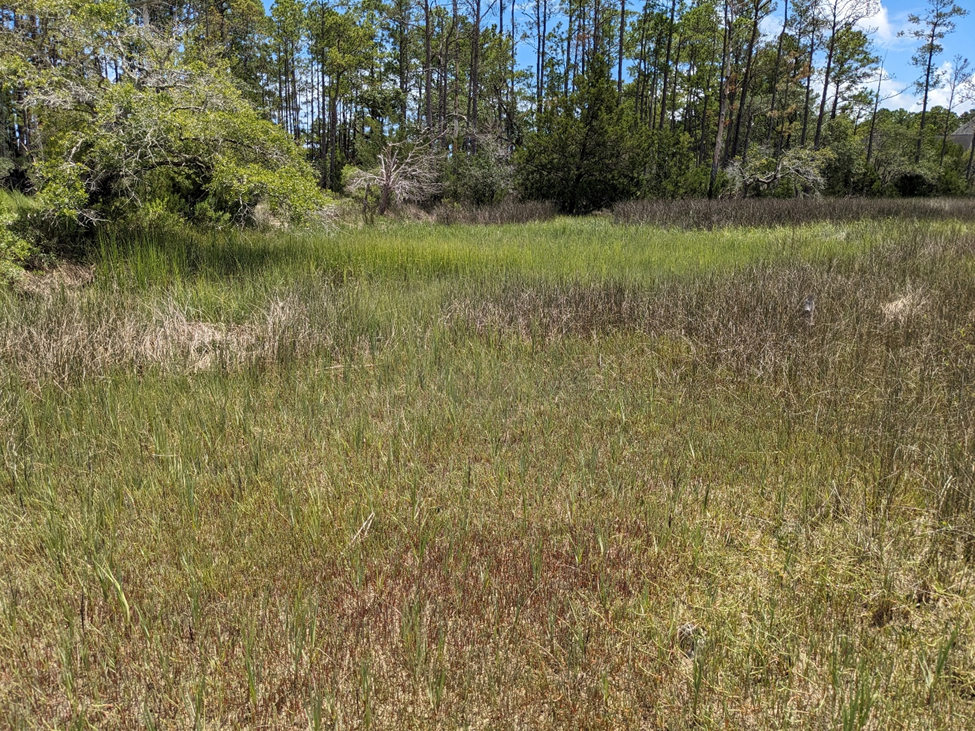
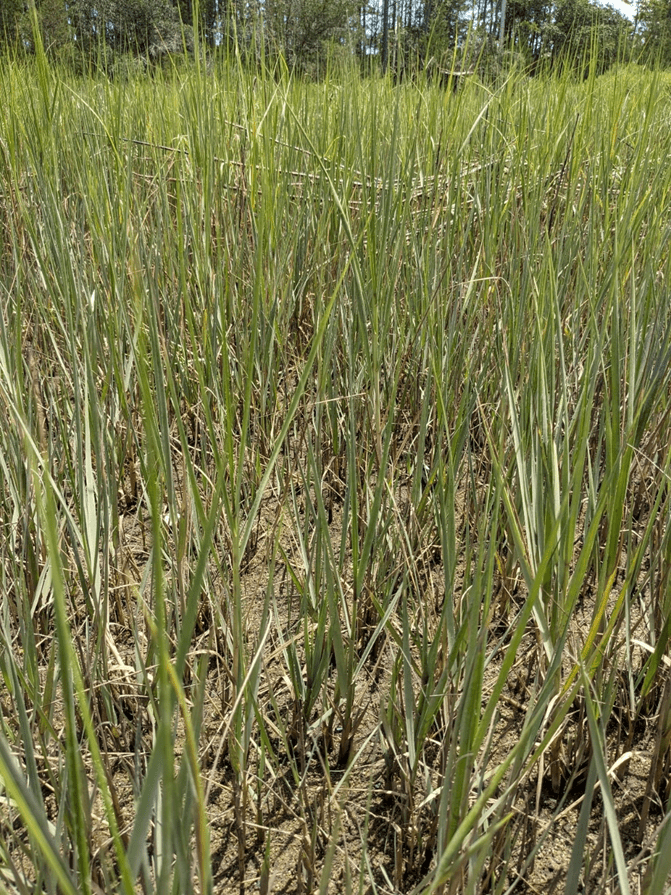
We found that plants growing along creekbanks and in the mid-marsh largely followed the expected patterns in trait trends in response to rapid SLR. In general, mid-marsh plants were growing taller over time, leading to more biomass production and flowering at taller heights during more recent years. Spartina growing along creekbanks were actually getting shorter through time and producing less biomass, potentially an early signal that inundation is becoming problematic in this portion of marshes. However, trends were present at some sites but weak (or opposite of our expectation) at others. This site-level variation obscured strong temporal changes. We attempted to predict differences in site- and marsh zone-level trends based on four abiotic variables (elevation, porewater salinity, soil N, and soil N:P), but none of these were effective at describing variation in plant trait trends.
The value of examining trait trends across a land (or sea) scape
Substantial spatial variability in salt marsh plant trait responses to changing water levels emphasizes the value of taking a landscape perspective when investigating temporal changes in plant traits. If we had only studied trait trends at one or two sites, we would likely have come to a different understanding of how this species is changing over time. At marshes where Spartina is responding to SLR, a suite of traits co-varied in response to water levels in ways that were consistent with expectations based on the well-defined growth-inundation relationship. Sites that were not responding as expected were likely affected more strongly by other factors known to impact plant growth, such as nutrient availability, salinity of the overlying water, or sediment accretion. Many animals rely on the structure provided by this foundation species for refuge and as a nursery during early life stages. Because plant traits such as stem density, height, and biomass are directly related to the structural complexity of marsh habitats, understanding how these traits are responding to sea level rise is critical to predict future habitat quality.


