Oliver Spacey, University of Oxford, UK, discusses his article: European mistletoe shares a similar demographic strategy with non-parasitic plants
Few plants are as enshrined in folklore as mistletoe, and much of this is owed to its unusual ecology. A parasitic plant that never touches the ground and was thus associated with divine power, European mistletoe (Viscum album) has fascinated druids and Vikings, and continues to be the subject of intense research today. Mistletoe is unusual in several ways, such as by lacking roots, growing in spherical clumps, requiring a host tree to survive and reproduce, and having the largest genome of any wild species in the British Isles.
Given such strange biology, we questioned whether mistletoe also exhibited a different demographic strategy than non-parasitic plants – that is, how the species invests in different stages of the life cycle. Previous studies have found that plants vary greatly in their demographic strategies, and such variation is captured by key axes of life history variation. For example, the fast-slow continuum is a measure of investment in the speed of growth, at the expense of survival, while the reproductive strategy axis measures frequency of reproduction with a presumed trade-off in offspring quality. Although we know that parasitic plants differ from non-parasitic plants in many aspects of their ecology, whether they differ in their overall demographic strategy has not been tested.
Size matters for mistletoe – but so does position
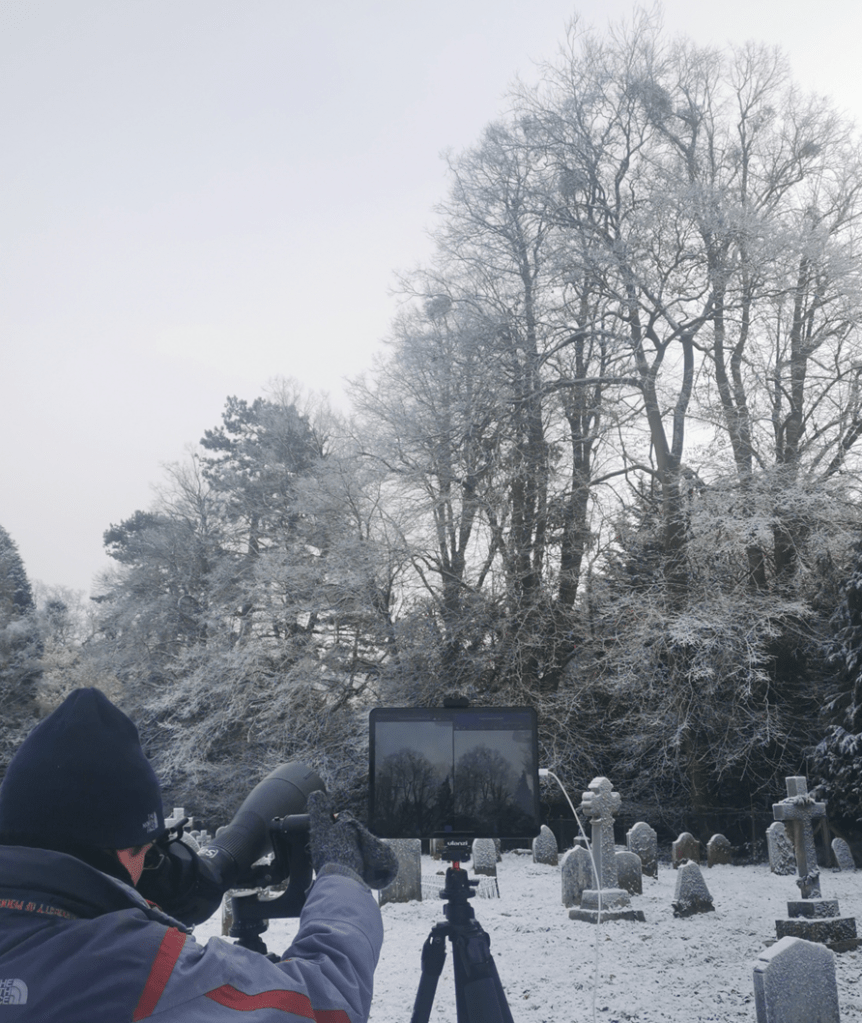
To investigate mistletoe’s demographic strategy, Rob Salguero-Gómez (University of Oxford), Owen Jones (SDU), and Sydne Record (University of Maine), with the help of Mick Crawley (Imperial College London), set up a population study in Silwood Park, UK. By returning each year for a decade, in the winter cold, we measured changes in mistletoe size (indicating growth), as well as their survival, fruiting (indicating reproduction), and position (height above ground). We found that, as expected, after establishment, mistletoe survival is unrelated to mistletoe size, though growth rates decrease and fruiting rates increase as mistletoes get larger. Less intuitively, mistletoes were more likely to fruit lower down in the tree, perhaps as they have earlier access to water and dissolved mineral ions in the tree vasculature than mistletoes higher in the tree.
A not-so-odd strategy
Given the effects of mistletoe size and position on its growth and reproduction, we then combined these relationships into a type of population model, specifically an integral projection model (IPM), which described the life cycle of the mistletoe. From this model, we estimated key metrics that indicated mistletoe’s demographic strategy, including its generation time, mean age at reproduction and mean lifespan.
Using the key summary statistics from our IPM, we compared the demographic strategy of mistletoe to hundreds of other species across the Plant Kingdom (and two other parasitic plants) for which there was demographic data stored in the COMPADRE database. Via a phylogenetically controlled principal component analysis (PCA), we could see where mistletoe’s demographic strategy fit in the context of other plant species.
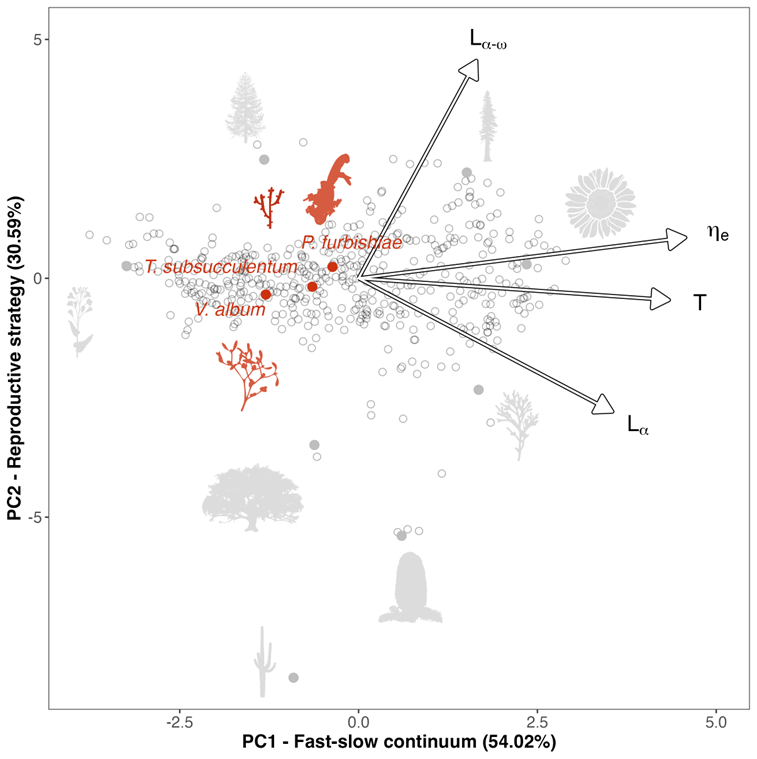
We expected mistletoe to be an outlier, yet we found that it places relatively centrally along our key fast-slow and reproductive strategy axes. Though mistletoe is odd in many aspects of its ecology (owing to adaptations to parasitism), its demographic strategy appears to not be so unique, and the same was true for the other parasites investigated. Though they obtain their resources in a different way compared to non-parasites, the investment of such resources is likely constrained in similar ways to non-parasitic plants, e.g., the trade-off between investment in survival and reproduction. Other non-parasitic plants, such as cacti and sequoias, exhibited more extreme demographic strategies. Hence, selection pressures other than those associated with parasitism are probably more important in shaping demographic strategies in plants. While mistletoes have evolved to parasitise trees via a suite of adaptations, alteration of their demographic strategy to suit their parasitic life cycle is either unnecessary or impossible.


