Wei Lin and Chengjin Chu, Sun Yat-sen University, discuss their article: Interannual rainfall variability promotes species coexistence primarily through relative nonlinearity in interaction strength
Ecologists often study species coexistence as if environmental conditions remain constant over time. But in the real world, rainfall can vary dramatically from one year to the next. Does this variability make it harder for plant species to coexist—or could it actually help maintain biodiversity?
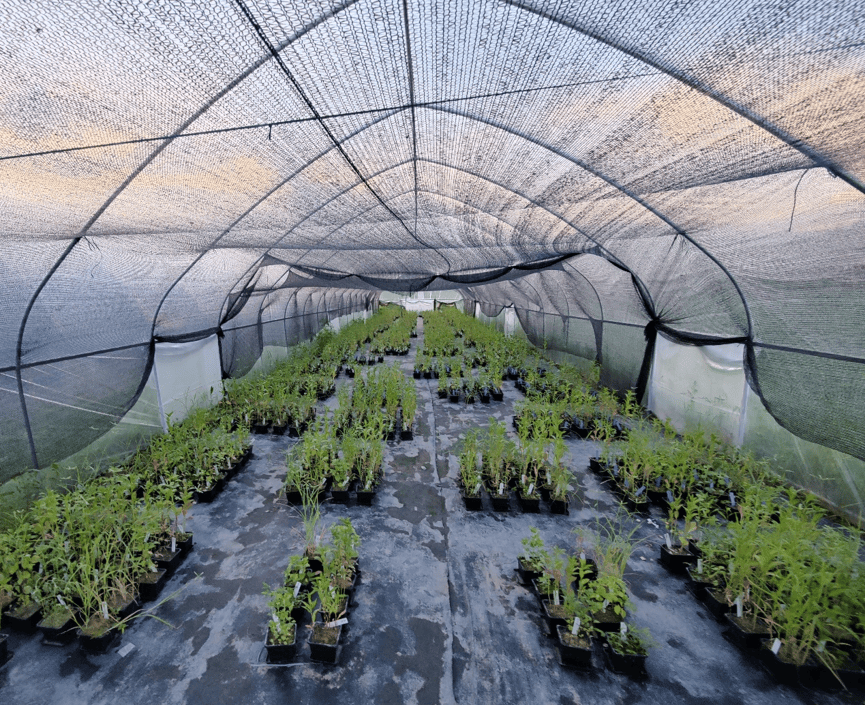
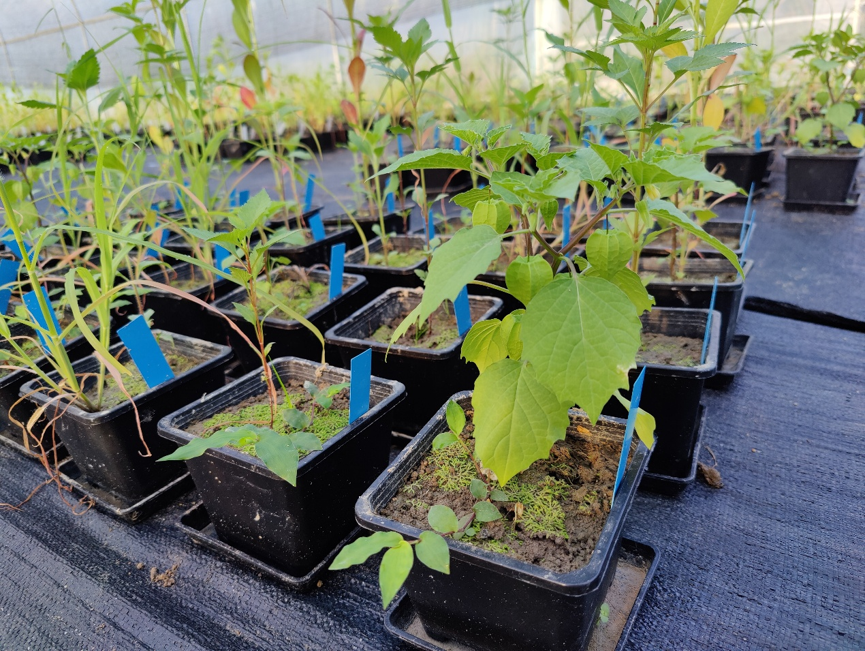
To find out, we conducted a greenhouse experiment in Fengkai County, Guangdong Province, in southern China. We selected eight annual herbaceous plant species that commonly co-occur in old fields at our study site. Using 120 years of local rainfall records, we identified four representative intra-annual rainfall regimes based on seasonal precipitation: consistent dry, consistent wet, post-flood dry, and pre-flood dry. We grew them in the greenhouse under these four simulated rainfall conditions for the full growing season. We then used the experimental data to model community dynamics, comparing coexistence outcomes when rainfall stayed constant over time versus when it followed the historical sequence of the four regimes.
We found that variability was not an obstacle to coexistence—it actually promoted it. Coexistence was more likely under variable rainfall than under constant conditions. Under historically variable rainfall, seven species pairs exhibited coexistence. Under constant average rainfall, by contrast, only two pairs did.
So, what drives coexistence in a fluctuating environment?
When rainfall varies from year to year, it affects plants in two main ways. First, it changes how each species performs on its own—for example, a species may produce many seeds in a wet year but far fewer in a dry one. Second, it changes how strongly species compete with each other—in some years competition is intense, while in other years it is weaker.
To our surprise, the main driver of coexistence was not how individual species responded directly to rainfall. Instead, what mattered most was how rainfall altered the competition strength between species. Removing this fluctuation in competitive intensity (what we term relative nonlinearity in interaction coefficients) caused four of the five coexisting pairs to lose coexistence altogether, whereas removing the fluctuation in direct species responses (relative nonlinearity in vital rates) did not change the coexistence status of species pairs.
What does this mean for plant community research?
Many previous studies on how species respond to climate change have often focused on individual species responses. Our findings show that interactions between species can also be highly sensitive to environmental variability. Changes in these interactions may even be more important for coexistence than the direct responses of individual species.
This insight is especially relevant as climate change makes rainfall increasingly variable and unpredictable in many regions. Although our study shows that historical patterns of rainfall variability can promote coexistence, future rainfall patterns may move beyond the conditions that plant communities have experienced in the past. The ecological effects of these novel patterns may therefore be very different, and greater variability will not necessarily benefit biodiversity.
To predict how plant communities will respond to climate change, we need to look beyond the responses of individual species. We must also consider how environmental fluctuations reshape the relationships between species over time. This adds complexity to biodiversity forecasts—but it is a complexity that we can no longer afford to ignore.


