Nicolas D. Zurbuchen, University of Zurich, discusses his article: Intraspecific trait variation responds consistently to global change drivers and mediates herbivory across unrelated plant species
Plants may look still, but they live in a busy world. Around them, insects and other invertebrates are feeding, fungi are infecting leaves, and the climate is changing. For plant ecologists, one big question is: can we predict how much plants will be eaten as environments change?
This is not easy. Drought, disease, and herbivory do not act in isolation. A dry summer may change the way a plant grows. A fungal infection may make leaves more or less attractive to herbivores. And different plant species—or even different populations of the same species—may respond in different ways.
In our study, we wanted to know whether plant traits could help us make sense of this complexity.
Looking within species
Ecologists often use plant traits to understand how plants function. For example, a thin, soft leaf may suggest that a plant grows fast, while a tougher leaf may suggest that a plant invests more in defence. These kinds of traits are useful because they link what a plant is like to what it does in an ecosystem.
However, many trait-based studies compare average values between species. We were interested in variation within species. In other words, do individuals or populations of the same species differ in ways that matter for herbivory?
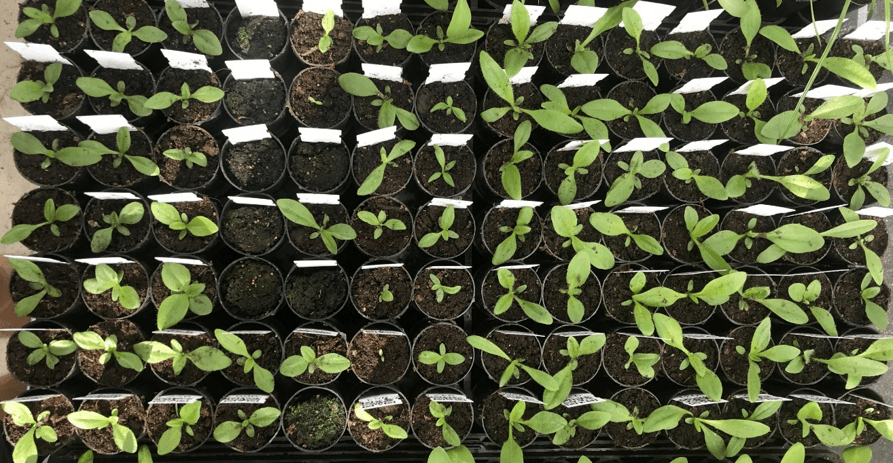
To test this, we grew plants from 65 populations belonging to 18 common grassland species. The seeds came from an elevation gradient in Switzerland, so some populations were adapted to warmer, low-elevation conditions and others to colder, high-elevation conditions. We then grew the plants together in a common garden, where they experienced the same local conditions.
Drought, fungi, and hungry herbivores
We manipulated two environmental factors that are highly relevant under global change: water availability and fungal pathogens. Some plants received less irrigation to simulate drought. Some were treated with fungicide to reduce fungal infection.
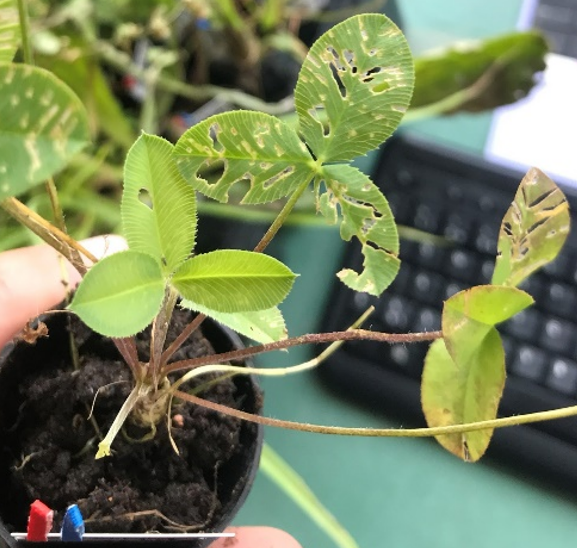
Towards the end of the growing season, we measured how much leaf area had been eaten by invertebrate herbivores. We also measured five plant traits, including leaf dry matter content, specific leaf area, leaf area, leaf water content, and aboveground biomass.
Our expectation was that drought and fungal disease might not only change plant traits, but also how strongly those traits predicted herbivory. For example, a trait that usually indicates defence might become less informative under drought.
A surprisingly stable pattern
What we found was both complex and encouraging. Drought and fungicide changed several plant traits, but their overall effects on herbivory were limited. This does not mean that nothing happened. Rather, different pathways seemed to counterbalance one another.
For example, drought increased leaf dry matter content, which was linked to lower herbivory. At the same time, other effects worked in the opposite direction. The result was a small overall effect of drought on herbivory.
The clearest pattern came from the traits themselves. Four of the five traits we measured were associated with herbivory. Most strikingly, plants with lower leaf dry matter content and higher specific leaf area tended to be eaten more. Surprisingly, these trait–herbivory associations did not strongly change under drought or fungicide treatment. This suggests that some links between plant form and herbivore feeding may be more stable than we expected, even when environmental conditions change.
Why elevation mattered
We also found that plants from higher elevations tended to be more susceptible to herbivory. One possible explanation is that high-elevation plants experienced the largest shift when grown in the low-elevation common garden. Another possibility is that they come from environments with low herbivore pressures, which may have reduced their defences over time through evolution.
Irrespective of the mechanism, this result reminds us that populations within a species are not interchangeable. Where a plant comes from can influence how it grows, how it defends itself, and how much it gets eaten.
What does this mean for plant ecology?
The most exciting message is that within-species trait variation can help us understand ecological processes. We often think about traits as differences between species, but our results show that variation within species can also have meaningful consequences.
As climate change continues to alter drought patterns, disease risk, and species interactions, we need tools that help us move from case-by-case observations towards broader predictions. Plant traits are not a magic shortcut, but they can provide a useful window into the mechanisms behind herbivory.
In simple terms: if we want to predict who gets eaten in a changing world, we should pay attention not only to which species are present, but also to how individuals and populations of those species differ.


