Sören Eliot Weber, West Virginia University, discusses his article: Fine-root responses to warming and elevated CO2 vary among plant functional types
Roots link plants to soil, shaping the responses of carbon, nutrient, and water cycles to climate change in peatlands. Peatlands in northern Minnesota (USA) have shallow water tables and canopies of black spruce and tamarack (Picea mariana and Larix laricina), with understories of shrubs in the family Ericaceae and rarer herbs and sedges. These plants have different root traits which should influence how these plants respond to climate change. We investigated how climate change impacts these roots as part of the Spruce and Peatland Responses Under Changing Environments experiment (SPRUCE). We experimentally warmed and added carbon dioxide to a boreal peat bog, and installed clear tubes, called minirhizotrons, to take root pictures. These images allowed us to track and identify roots from 2015-2021, distinguishing how shrubs, trees, and herbs respond to climate change.

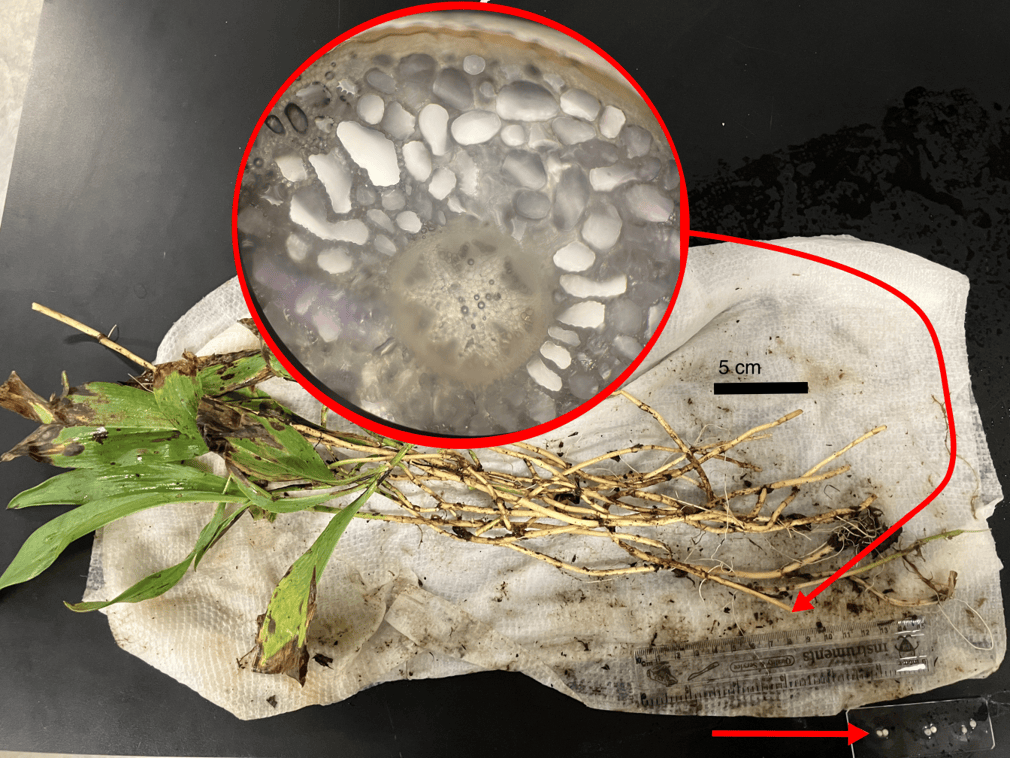
Shrub roots were more responsive to warming than roots of trees or herbs. These shrub and tree roots also grew deeper with declining water tables, whereas herbs did not grow deeper when these water tables dropped. This is likely because herb roots have aerenchyma, air carrying structures that keep deep herb roots from drowning underneath the high water tables in boreal bogs, like at SPRUCE. Incidentally, this is the first paper that I know of which reports anatomical evidence of aerenchyma in Maianthemum trifolium rhizomes (thanks to Kyle Pearson who sent the samples!). We also found that while elevated CO2 does not strongly increase root production, it does accelerate the rate at which fine-root biomass of shrubs increases with warming. These increases in shrub fine-root biomass with elevated CO2 and warming is a very similar response to results previously reported for aboveground biomass, where shrub aboveground biomass increased with warming and elevated CO2 at the expense of herbaceous vegetation.
None of this work would have been possible without our friend Joanne Childs, who tragically passed away in June 2024. Joanne was our root identification expert, she was able to identify each root in our image set as either shrub, tree, or herb. I am incredibly lucky for the brief time that I got to share with her at, and outside of, work. Her efforts broadly and in this paper specifically have advanced our understanding of how fine-roots actually work in natural settings.


