Vincent Buness, Swedish University of Agricultural Sciences, discusses his article: Distinct diversity trajectories of boreal wood-inhabiting fungi following fire vs. clear-cutting
As humans, we tend to trust our senses and assume that we can perceive most of what surrounds us. When we walk through the forest, we see trees with their stems and canopy, and we can hear birds singing. Yet our environment is teeming with life that we cannot perceive. Fungi are everywhere – in our food, on our skin, and throughout forests. Despite this, forests are usually described and evaluated in terms of trees, and sometimes animals, effectively overlooking an entire kingdom of life that decomposes deadwood, recycles nutrients, and provides food for other organisms such as beetles. When we do look at fungi, they offer a window into the living world beyond the trees – and can show us that even though the trees are regrowing, this does not mean that all parts of the forest have recovered.
From fire to clear-cutting
Historically, in Fennoscandia (Sweden, Finland, and Norway), forest fires were the most dominant major disturbance type. Today, however, clear-cutting is the most common method used to rejuvenate forests. After clear-cutting, trees are generally planted, and forest canopies typically close again within a few decades. To an untrained eye, these stands can look structurally similar to more natural forests. However, there is a fundamental difference in one key aspect: deadwood. After clear-cutting, deadwood does not return to levels found in unmanaged forests, even after many decades. For wood-inhabiting fungi, this should matter – but because these organisms are largely invisible and therefore often go undetected, the recovery of their communities is generally overlooked.
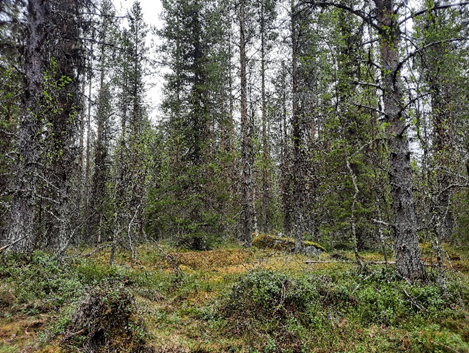
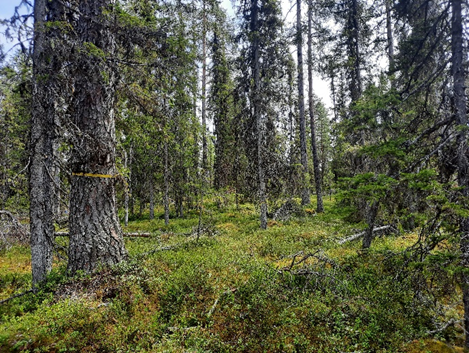
A 65-year-old managed forest (left) and a 288-year-old unmanaged forest (right). The forests appear similar, but the fungal community reveals a stark difference: the managed stand contains far less deadwood and supports much lower diversity of wood-inhabiting fungi. These two stands differed by more than five-fold in fungal species richness (80 in the managed vs. 469 species in the unmanaged stand). Photos by Vincent Buness.
Making the unseen visible
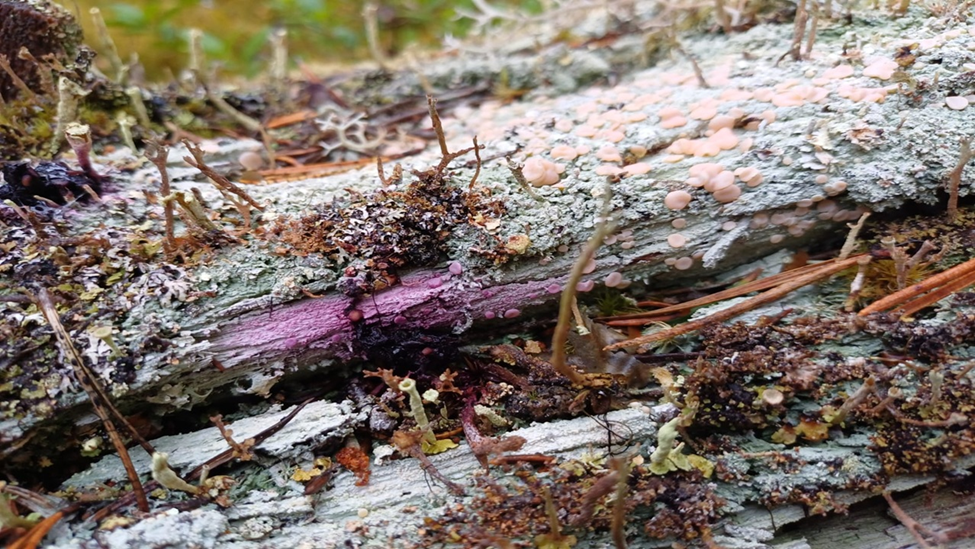
The most intuitive way to identify fungi is to look at their fruiting bodies, which can be remarkably diverse in colour, size, and form. However, the majority of fungal biomass can be hidden within the deadwood; some species form fruiting bodies only rarely, and others do not form visible fruiting bodies at all. As a result, a substantial part of fungal diversity remains hidden. Fortunately, in recent decades, scientists have developed the ability to detect fungi from their DNA. Using DNA sequencing, we detected around 1,800 genetically distinct fungal taxa living inside deadwood, many times more than were found with fruiting-body surveys alone. Importantly, DNA did not just reveal more species; it also changed the picture of post-disturbance recovery. While fruiting-body surveys alone mostly find the highest number of species immediately after fire, the combined dataset showed that in unmanaged stands, fungal diversity accumulates steadily over centuries without saturating even in the oldest stands – a timescale of recovery that typical forestry rotations of 80–100 years cannot accommodate.
Because deadwood is the principal habitat of wood-inhabiting fungi, we expected deadwood volume to be the main driver of species richness. However, we found that quantity alone was not sufficient. Deadwood diameter and decay stage were also important predictors of fungal diversity, with the highest species richness found in stands containing very large logs in advanced decay. Yet a log with a diameter of 50 cm in advanced decay takes several hundreds of years to develop, especially in northern Sweden, where trees grow – and decompose – very slowly. Such habitat features cannot be created within 100-year rotations but instead require hundreds of years without major disturbance.
Fire as a creator, not a destroyer
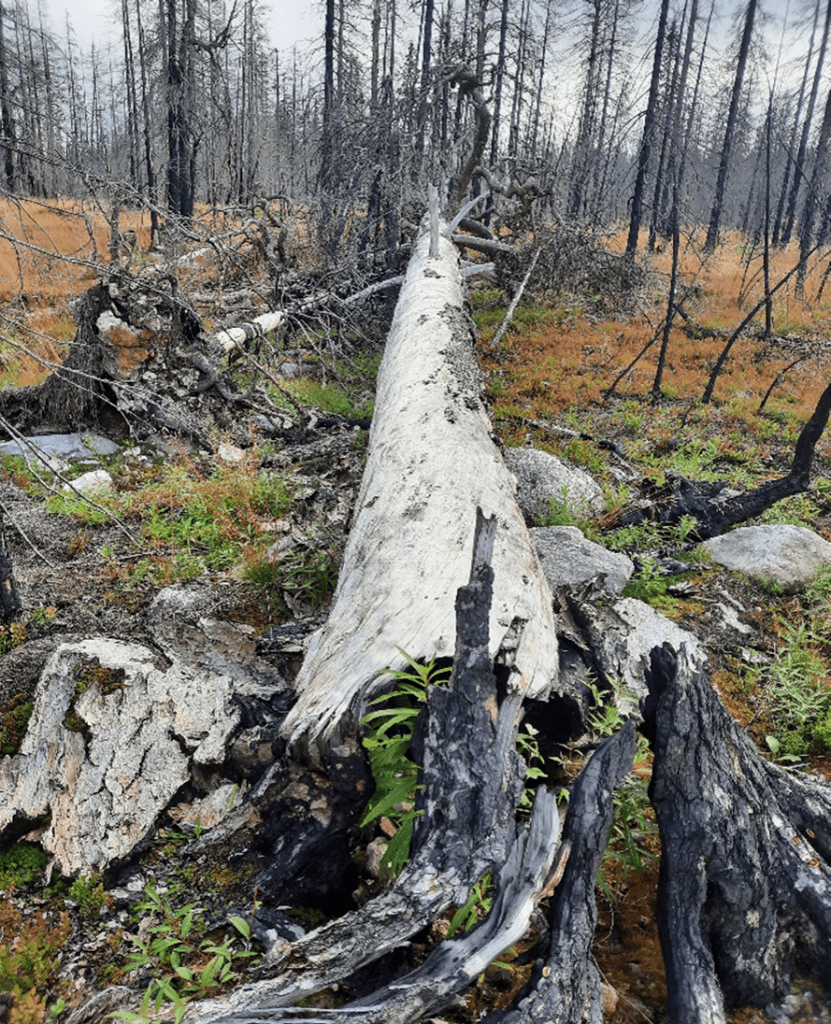
Fire is often seen as purely destructive, but this captures only one part of the story. In contrast, fire creates structures that form long-lasting ecological legacies. Unlike clear-cutting, fire does not remove deadwood but instead creates it. Immediately after a forest fire, we find a wide range of deadwood types, including standing and fallen deadwood, small and large logs, and often multiple tree species. This newly created deadwood then begins to decompose and provides habitat continuity for deadwood-inhabiting fungi for decades or even centuries. As old logs decay, new trees die and produce fresh deadwood, maintaining an unbroken supply of substrate across time. In this way, fire supports recovery trajectories that differ fundamentally from clear-cutting, where deadwood is often sparse and homogeneous.
The bigger picture
In essence, we can regrow forests, but we cannot create habitat continuity for wood-inhabiting fungi. Many fungal species depend on long, undisturbed periods of growth, death, and decay, sometimes spanning hundreds of years. When this continuity is broken, it cannot be recreated within typical forestry rotations. Because fungi drive deadwood decomposition and support food webs that include beetles and many other organisms, their loss signals far more than a decline in fungal diversity alone. Maintaining these communities, and the ecosystem functions they support, ultimately depends on preserving the old-growth forests where they persist.

 jecologyblog.com